 Astrologger
Kaal Bhairav Mantra
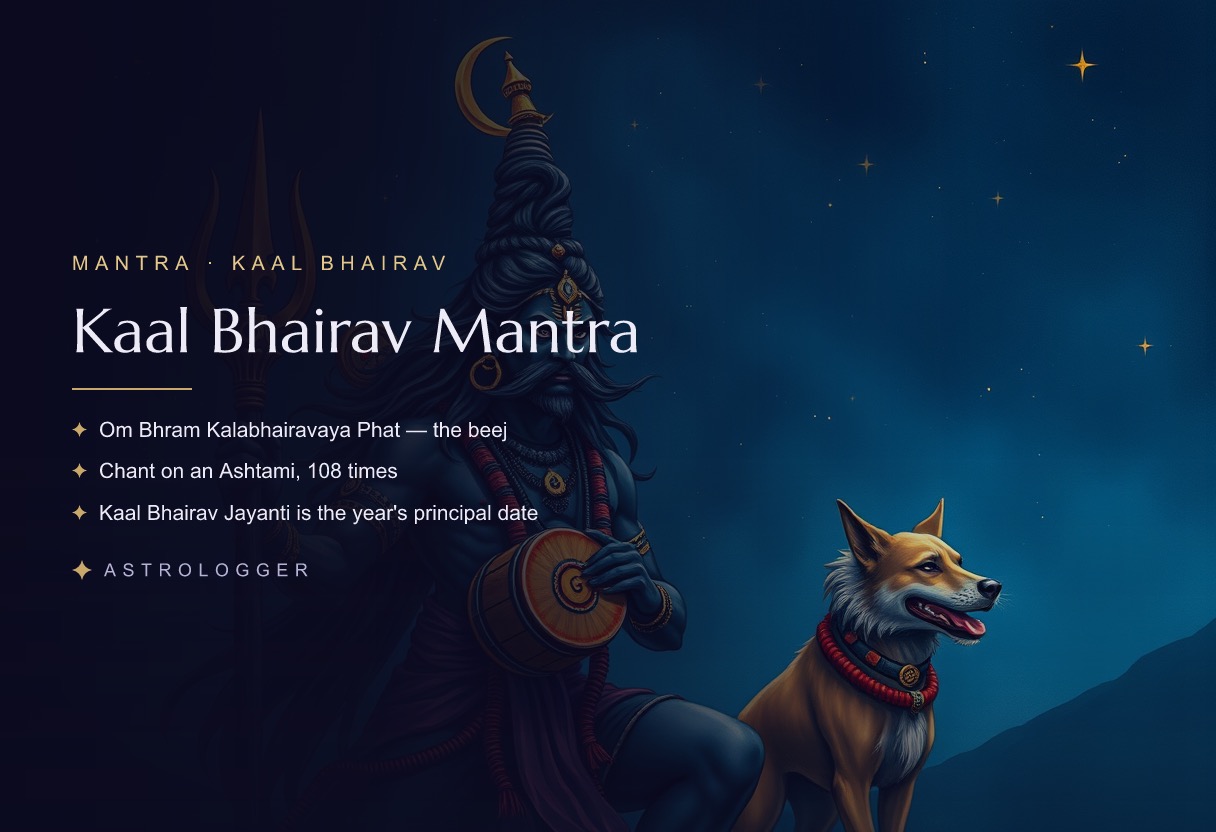
Kaal Bhairav is Shiva in his fierce, time-bound form — "kaal" meaning both time and death — held in tradition to guard the city of Kashi and to be approached for protection from fear, enemies and what tradition calls negative influence. Batuk Bhairav, covered elsewhere in this section, is his gentle child form; the mantras below are kept for the fierce form directly. As with the other deity mantras here, there is no single one — the family below serves different occasions.
The 4 Kaal Bhairav Mantras
"Kaal Bhairav Mantra" is not a single verse. These are the forms in traditional use, each with its own purpose and count.
| Form | Opening | Count |
|---|---|---|
| Kaal Bhairav Beej Mantra | ॐ भ्रं कालभैरवाय फट् | 108 daily, or on an Ashtami |
| Kaal Bhairav Moola Mantra | ॐ कालभैरवाय नमः | 108 daily |
| Kaal Bhairav Gayatri Mantra | ॐ कालकाय विद्महे कालतीतया धीमहि। | 108 |
| Kaal Bhairav Ashtakam (opening) | देवराजसेव्यमानपावनाङ्घ्रिपङ्कजं व्यालयज्ञस | — |
Kaal Bhairav Beej Mantra
ॐ भ्रं कालभैरवाय फट्
Om Bhrāṁ Kālabhairavāya Phaṭ
The seed form. "Bhrāṁ" carries no dictionary sense of its own — a tantric sound-seed tuned to the fierce aspect of Shiva — and the mantra closes with phaṭ, the weapon-syllable used where a mantra is set like a guard, the same ending the Batuk Bhairav page notes for its own beej mantra.
Count: 108 daily, or on an Ashtami
Kaal Bhairav Moola Mantra
ॐ कालभैरवाय नमः
Om Kālabhairavāya Namaḥ
The root form, and the shortest. A bare salutation to him by name, with no seed syllable attached. This is the one usually given to someone beginning the practice.
Count: 108 daily
Kaal Bhairav Gayatri Mantra
ॐ कालकाय विद्महे कालतीतया धीमहि। तन्नो कालभैरवः प्रचोदयात्॥
Om Kālakāya Vidmahe Kālatītayā Dhīmahi, Tanno Kālabhairavaḥ Prachodayāt.
Built on the Gayatri metre. It names him as kaal — time itself — and then as the one beyond time, before asking that Kaal Bhairav direct the intellect: a deliberate pairing, since he is held to be both bound to time and its master. Published versions vary in the opening epithet; the sense stays the same across them.
Count: 108
Kaal Bhairav Ashtakam (opening)
देवराजसेव्यमानपावनाङ्घ्रिपङ्कजं व्यालयज्ञसूत्रमिन्दुशेखरं कृपाकरम्। नारदादियोगिवृन्दवन्दितं दिगंबरं काशिकापुराधिनाथकालभैरवं भजे॥
Devarājasevyamāna Pāvanāṅghripaṅkajaṁ Vyālayajñasūtramindusekharaṁ Kṛpākaram, Nāradādiyogivṛndavanditaṁ Digambaraṁ Kāśikāpurādhinātha Kālabhairavaṁ Bhaje.
The opening verse of the Kaal Bhairav Ashtakam, attributed to Adi Shankaracharya. It describes before it addresses: his pure lotus feet served by the king of gods, a serpent worn as his sacred thread, the crescent moon on his crest, compassionate, worshipped by sages headed by Narada, sky-clad, lord of the city of Kashi — and closes with "I worship Kaal Bhairav." The Ashtakam runs to eight verses; this opening is the one most often quoted on its own.
When and how to chant
Day: Ashtami of either fortnight — not tied to a single weekday — with Margashirsha Krishna Ashtami (Kaal Bhairav Jayanti) the most important date of the year
- Evening or night, after a bath — Bhairav is approached after dark rather than at dawn, the same convention the Batuk Bhairav page notes.
- Face south or west. A black-thread or rudraksha mala is used; count in rounds of 108.
- Light a lamp of mustard or sesame oil rather than ghee. Offer black or red flowers.
- Feed dogs, or set food aside for them, as part of the observance — the dog is his vahana.
- Ashtami is the tithi kept across both fortnights, and Margashirsha Krishna Ashtami — Kaal Bhairav Jayanti — the day most often chosen to begin a practice.
What tradition holds
Kaal Bhairav is approached for protection — from fear, from hostile circumstances, from what tradition calls negative influence — and for steadiness of mind through a frightening or uncertain stretch. On Kaal Bhairav Ashtami, some traditions also recite his eight names together — Asitanga, Ruru, Chanda, Krodha, Unmatta, Kapala, Bhishana and Samhara — held to be his eight fierce forms, each linked to a direction. These are the reasons tradition gives for keeping these mantras; they are not claims about outcomes, and nothing here is a substitute for dealing with a real threat by real means.
Watch and chant along
Related mantras
Frequently asked questions
Which is the Kaal Bhairav mantra?
There is no single one. The moola mantra, Om Kālabhairavāya Namaḥ, is the shortest and the one usually given to a beginner. The beej mantra, Om Bhrāṁ Kālabhairavāya Phaṭ, is the most widely chanted seed form. The gayatri and the opening of the Shankaracharya-composed Ashtakam are set out above, each with Devanagari, transliteration and sense.
How can Kaal Bhairav be pleased?
In the evening after a bath, facing south or west, with a lamp of mustard or sesame oil rather than ghee, and black or red flowers offered. Food is set aside for dogs as part of the observance — the dog is his vahana. Ashtami is the tithi kept, and Margashirsha Krishna Ashtami, Kaal Bhairav Jayanti, the day most often chosen to begin.
What is the beej mantra of Bhairav?
Om Bhrāṁ Kālabhairavāya Phaṭ for Kaal Bhairav specifically. "Bhrāṁ" is a tantric seed syllable tuned to his fierce aspect, and phaṭ is the weapon-syllable that closes mantras kept for protection.
What are the 8 Bhairav mantras?
This usually refers to the Ashta Bhairava — eight fierce forms of Shiva, each linked to a direction: Asitanga, Ruru, Chanda, Krodha, Unmatta, Kapala, Bhishana and Samhara. Some traditions recite the eight names together on Kaal Bhairav Ashtami rather than treating each as a separate elaborate mantra.