 Astrologger
Kali Mantra
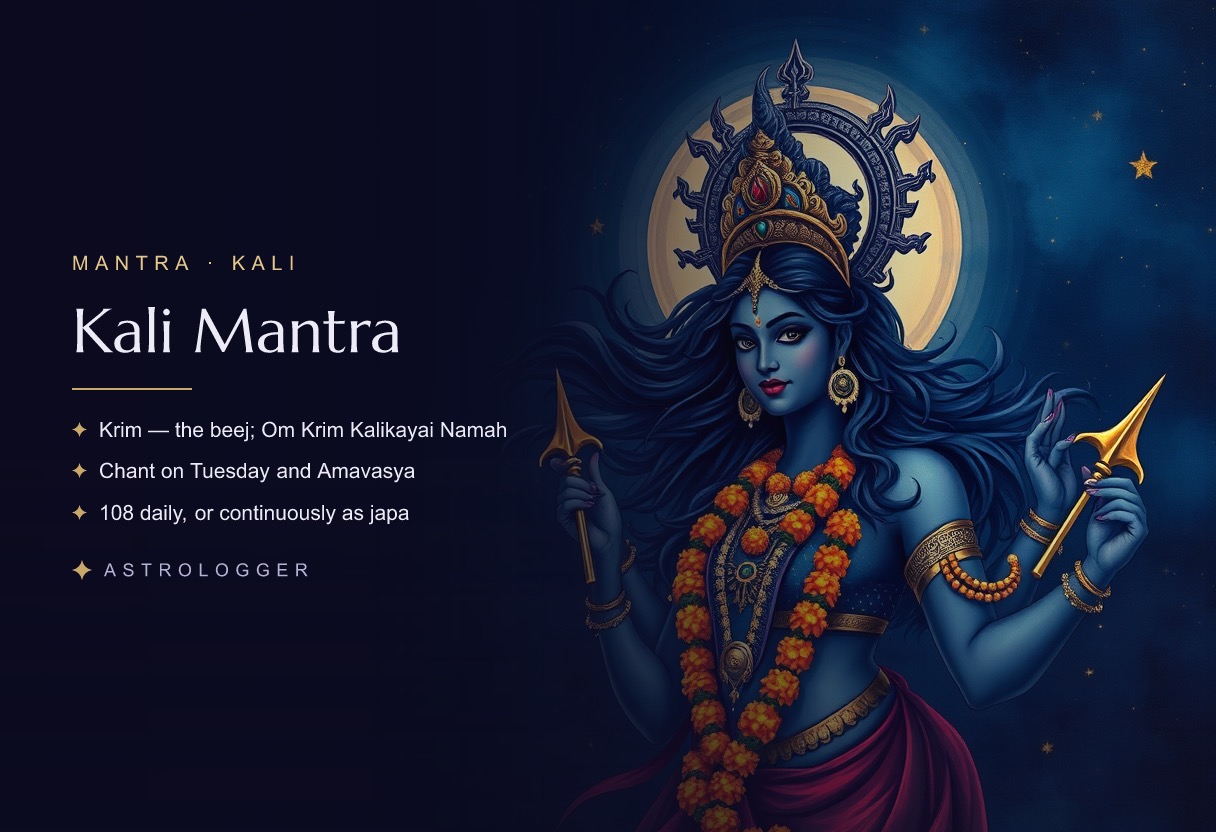
Kali is Shakti in her most fierce and direct form — time itself in a feminine aspect, held in tradition to destroy illusion and fear rather than soften them. She is one of the Dasha Mahavidya, the ten great wisdom goddesses, and is approached where a gentler deity is felt to be insufficient for what is actually wrong. Mantras addressed to her are chanted during Kali Puja and Gupt Navratri, and by anyone facing something they experience as genuinely overwhelming. As with the other deity mantras here, there is no single one — the family below serves different occasions.
The 4 Kali Mantras
"Kali Mantra" is not a single verse. These are the forms in traditional use, each with its own purpose and count.
| Form | Opening | Count |
|---|---|---|
| Kali Beej Mantra | क्रीं | 108 daily, or continuously as japa |
| Kali Moola Mantra | ॐ क्रीं कालिकायै नमः | 108 daily |
| Kali Gayatri Mantra | ॐ महाकाल्यै च विद्महे श्मशानवासिन्यै च धीम | 108 |
| Kali Dhyana Shloka | करालवदनां घोरां मुक्तकेशीं चतुर्भुजाम्। | — |
Kali Beej Mantra
क्रीं
Krīṁ
A single syllable, and considered one of the most powerful beej mantras in tantric tradition — carrying no dictionary sense of its own, tuned to Kali directly. It appears inside nearly every other mantra addressed to her, including the ones below.
Count: 108 daily, or continuously as japa
Kali Moola Mantra
ॐ क्रीं कालिकायै नमः
Om Krīṁ Kālikāyai Namaḥ
The beej syllable combined with a salutation by name. This is the one usually given to someone beginning the practice.
Count: 108 daily
Kali Gayatri Mantra
ॐ महाकाल्यै च विद्महे श्मशानवासिन्यै च धीमहि। तन्नो काली प्रचोदयात्॥
Om Mahākālyai Cha Vidmahe Śmaśānavāsinyai Cha Dhīmahi, Tanno Kālī Prachodayāt.
Built on the Gayatri metre. It names her Mahakali, and dweller of the cremation ground — an image tradition reads as her standing beyond the fear of death rather than being morbid for its own sake — then asks that Kali direct the intellect.
Count: 108
Kali Dhyana Shloka
करालवदनां घोरां मुक्तकेशीं चतुर्भुजाम्। कालिकां दक्षिणां दिव्यां मुण्डमालाविभूषिताम्॥
Karālavadanāṁ Ghorāṁ Muktakeśīṁ Chaturbhujām, Kālikāṁ Dakṣiṇāṁ Divyāṁ Muṇḍamālāvibhūṣitām.
A dhyana verse from tantric tradition, held before worship to bring her form to mind: terrible of face, fierce, hair unbound, four-armed, of the Dakshina Kali form, divine, adorned with a garland of skulls. The imagery is deliberately fearsome — tradition holds that approaching her as she actually is, rather than softened, is the point.
When and how to chant
Day: Tuesday and Amavasya (the new moon) above all — Kali Puja itself falls on Diwali's Amavasya in Bengali tradition
- Night is the time tradition keeps for her, unlike the dawn or morning kept for gentler deities; Tuesday and Amavasya are the occasions most associated with her.
- Face south while chanting. Red hibiscus flowers and red cloth are the usual offerings.
- A mala of rudraksha is traditional; count in rounds of 108, or continuous repetition without a formal count for the beej alone.
- Kali Puja, observed on Diwali's Amavasya in Bengali and Eastern Indian tradition, is the year's principal occasion.
What tradition holds
Kali is approached to destroy fear and illusion directly rather than manage them gradually — tradition frames her as the form Shakti takes when a situation calls for confronting what is actually wrong rather than working around it. She is held in tantric tradition to be ultimately protective despite her fearsome form, a mother to those who approach her honestly. These are the reasons tradition gives for keeping these mantras; they are not claims about outcomes.
Watch and chant along
Related mantras
Frequently asked questions
What is the mantra of Kali ji?
There is no single one. Krīṁ alone is her most powerful seed syllable. The moola mantra, Om Krīṁ Kālikāyai Namaḥ, combines it with a salutation. The gayatri and a dhyana shloka are set out above as well, each with Devanagari, transliteration and sense.
What are the 108 mantras of Maa Kali?
This usually refers to her 108 names (Ashtottara Shatanamavali) recited together, one with each bead of a mala — a different tradition from the handful of distinct mantras this page covers, and one this page does not reproduce in full.
What is the stuti mantra of Kali?
The dhyana shloka above — Karālavadanāṁ Ghorāṁ Muktakeśīṁ Chaturbhujām — functions as a verse of description held before worship, bringing her fierce form to mind rather than praising her in the way a longer stotra would.
What is the gupt (secret) mantra of Kali?
Tantric tradition keeps more elaborate forms that are transmitted directly from a guru rather than published — this page gives the beej, moola, gayatri and dhyana forms that are openly circulated, and does not claim to cover guru-transmitted practice.