 Astrologger
Ketu Mantra
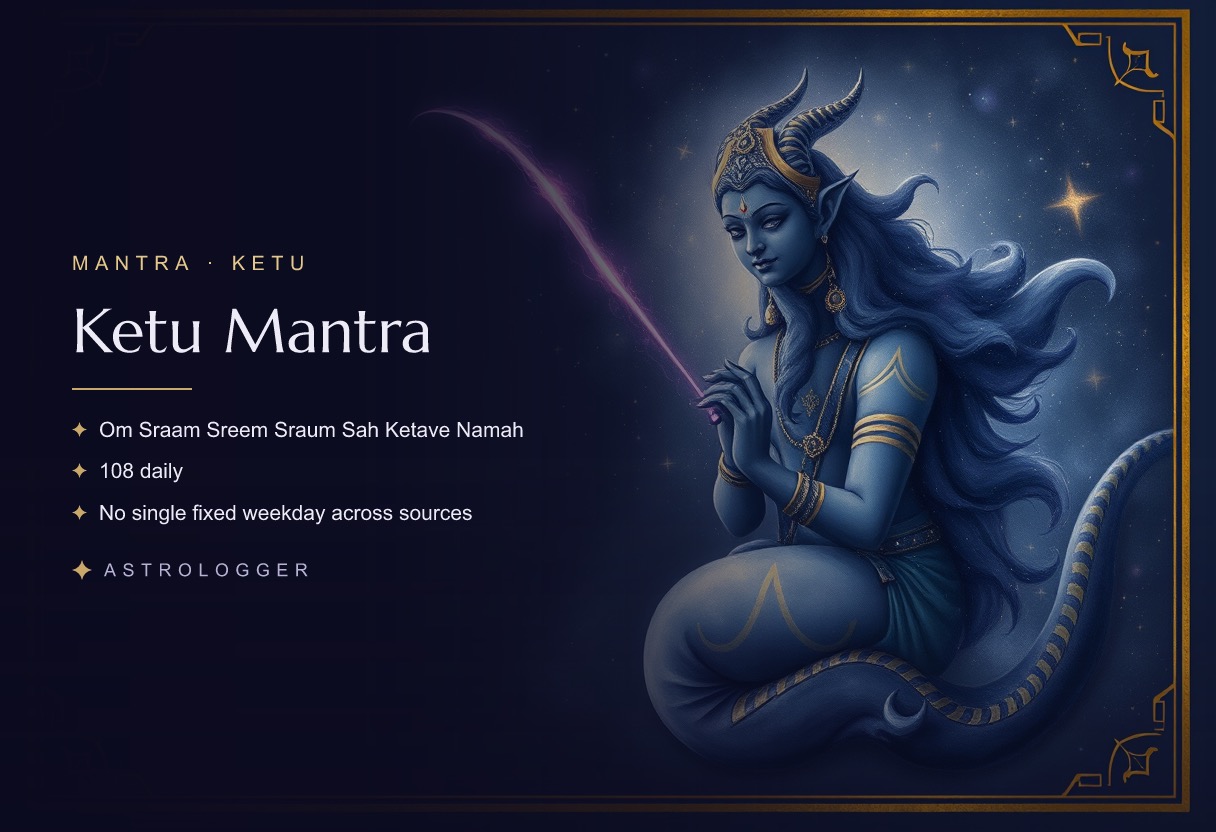
Ketu is the south lunar node — a shadow graha with no physical body, held in Jyotish to govern detachment, past-life karma, spirituality and sudden, unexplainable events. Mantras addressed to him are chanted during Ketu Mahadasha and Antardasha, where Kaal Sarp Dosha is suspected, and by anyone working through a stretch marked by confusion or isolation. As with the other graha mantras here, there is no single one — the family below serves different occasions.
The 4 Ketu Mantras
"Ketu Mantra" is not a single verse. These are the forms in traditional use, each with its own purpose and count.
| Form | Opening | Count |
|---|---|---|
| Ketu Beej Mantra | ॐ स्रां स्रीं स्रौं सः केतवे नमः | 108 daily |
| Ketu Moola Mantra | ॐ कें केतवे नमः | 108 daily |
| Ketu Gayatri Mantra | ॐ अश्वध्वजाय विद्महे शूलहस्ताय धीमहि। | 108 |
| Navagraha Stotra (Ketu verse) | पलाशपुष्पसंकाशं तारकाग्रहमस्तकम्। | — |
Ketu Beej Mantra
ॐ स्रां स्रीं स्रौं सः केतवे नमः
Om Srāṁ Srīṁ Srauṁ Saḥ Ketave Namaḥ
The seed form. Srāṁ, srīṁ and srauṁ carry no dictionary sense of their own — tantric sound-seeds tuned to the graha — and the mantra closes as a plain salutation to Ketu by name.
Count: 108 daily
Ketu Moola Mantra
ॐ कें केतवे नमः
Om Keṁ Ketave Namaḥ
"Keṁ" is Ketu's own seed syllable; the rest is a bare salutation by name. This is the one usually given to someone beginning the practice.
Count: 108 daily
Ketu Gayatri Mantra
ॐ अश्वध्वजाय विद्महे शूलहस्ताय धीमहि। तन्नः केतुः प्रचोदयात्॥
Om Aśvadhvajāya Vidmahe Śūlahastāya Dhīmahi, Tannaḥ Ketuḥ Prachodayāt.
Built on the Gayatri metre. It names him Ashvadhvaja, "the horse-bannered one", holding a shoola — a trident or spear — in hand, then asks that Ketu direct the intellect.
Count: 108
Navagraha Stotra (Ketu verse)
पलाशपुष्पसंकाशं तारकाग्रहमस्तकम्। रौद्रं रौद्रात्मकं घोरं तं केतुं प्रणमाम्यहम्॥
Palāśapuṣpasaṅkāśaṁ Tārakāgrahamastakam, Raudraṁ Raudrātmakaṁ Ghoraṁ Taṁ Ketuṁ Praṇamāmyaham.
Ketu's verse from the Navagraha Stotra, the nine-verse hymn attributed to the sage Vyasa that gives one verse to each graha. It describes him as the colour of the palash flower, foremost among the stars, fierce and wrathful by nature, before bowing to him.
When and how to chant
Day: No single fixed weekday — sources disagree between Tuesday and Saturday, which is why this site's own navagraha data leaves Ketu without one
- Morning is the time usually kept; where a specific day is observed, Tuesday or Saturday are the two most commonly cited.
- Face south-west while chanting, seated on a kush-grass mat where possible. A rudraksha or agate (hakik) mala is traditional; count in rounds of 108.
- Sesame, a multi-coloured or brown blanket, and offerings to the needy or to dogs are commonly associated with Ketu, overlapping with what tradition keeps for Rahu.
- Grey or brown is his colour; cat's eye (lehsunia) is the gemstone tradition associates with him.
What tradition holds
These mantras are traditionally taken up during Ketu Mahadasha and Antardasha, where Kaal Sarp Dosha is suspected, and for matters of spirituality, detachment, and the confusion or sudden loss tradition associates with an afflicted Ketu. A well-placed Ketu is held to give intuition and depth; an afflicted one, isolation or disorientation. These are the reasons tradition gives for keeping these mantras; they are not claims about outcomes.
Is Ketu actually placed against you?
A mantra is chosen for a placement, not for a planet in the abstract. Whether Ketu forms Kaal Sarp Dosha in your chart, is running your Mahadasha, or neither, depends on your birth date, time and place — which is a calculation, not a guess.
Watch and chant along
Related mantras
Frequently asked questions
Which is the mantra of Ketu?
There is no single one. The shortest is the moola mantra, Om Keṁ Ketave Namaḥ. The beej mantra, Om Srāṁ Srīṁ Srauṁ Saḥ Ketave Namaḥ, is the more widely chanted seed form. The gayatri and the Navagraha Stotra verse are set out above, each with Devanagari, transliteration and sense.
How can Ketu be pleased?
Through the mantras above, chanted facing south-west on a rudraksha or agate mala, and through the donations tradition associates with him — sesame, a multi-coloured or brown blanket, and offerings to the needy or to dogs.
How should the Ketu mantra be chanted 108 times?
Facing south-west, counting one full round of 108 beads on a rudraksha or agate mala. Morning is the time usually kept; a specific weekday is not consistently fixed across sources.
When should Ketu mantras be chanted?
During Ketu Mahadasha or Antardasha, where Kaal Sarp Dosha is suspected in the chart, and generally in the morning — rather than on one fixed weekday, since sources disagree on which day is his.