 Astrologger
Mangal Mantra
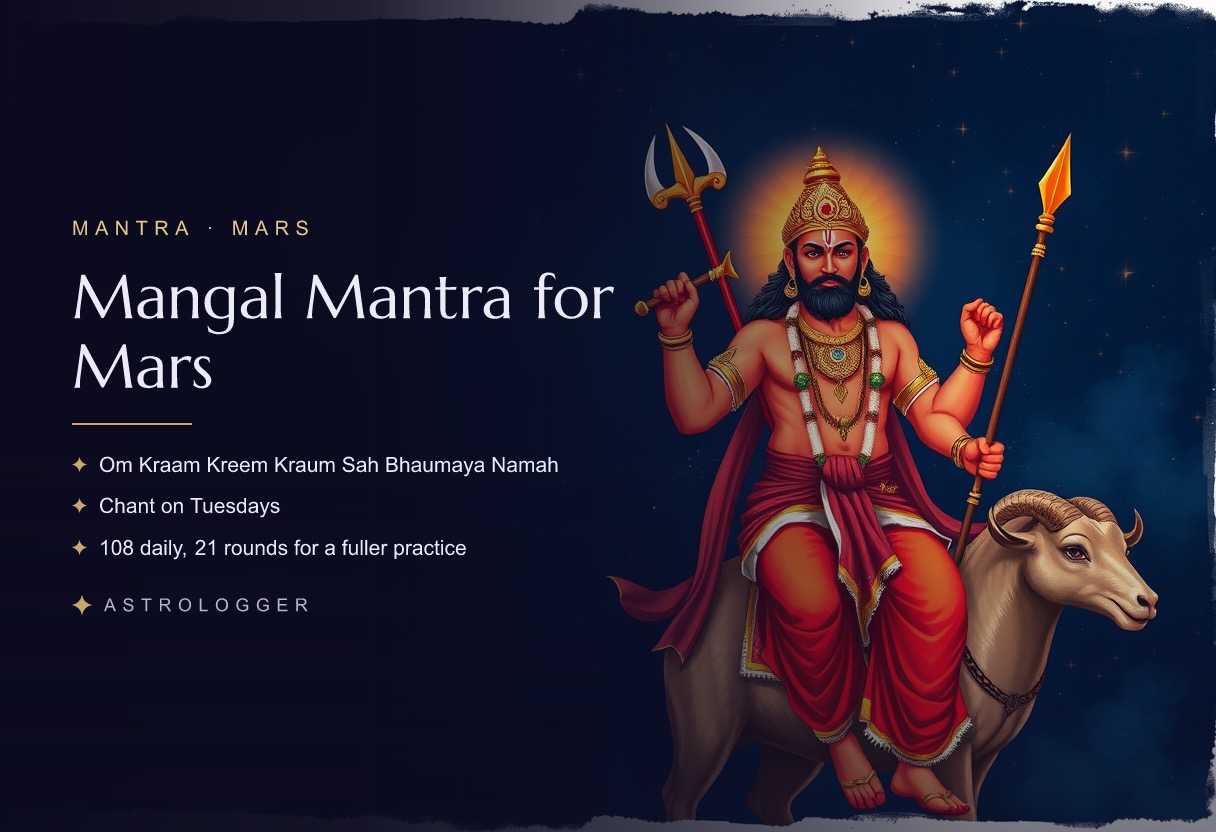
Mangal is the graha of energy, courage and land — Mars in the Western scheme, and in Jyotish held to be Bhauma, son of the Earth (Bhumi). Mantras addressed to him are chanted on Tuesdays, during Mangal Dosha (popularly called Manglik dosha) and Mangal Mahadasha, and by anyone needing resolve through a demanding, high-energy stretch. As with the other graha mantras here, there is no single one — the family below serves different occasions.
The 4 Mangal Mantras
"Mangal Mantra" is not a single verse. These are the forms in traditional use, each with its own purpose and count.
| Form | Opening | Count |
|---|---|---|
| Mangal Beej Mantra | ॐ क्रां क्रीं क्रौं सः भौमाय नमः | 108 daily, or 21 rounds on a Tuesday for a fuller practice |
| Mangal Moola Mantra | ॐ अं अंगारकाय नमः | 108 daily, facing east after sunrise |
| Mangal Gayatri Mantra | ॐ अंगारकाय विद्महे शक्तिहस्ताय धीमहि। | 108 |
| Mangal Stotra (opening) | मङ्गलो भूमिपुत्रश्च ऋणहर्ता धनप्रदः। | — |
Mangal Beej Mantra
ॐ क्रां क्रीं क्रौं सः भौमाय नमः
Om Krāṁ Krīṁ Krauṁ Saḥ Bhaumāya Namaḥ
The seed form, and the one nearly every chanting recording online is built around. Krāṁ, krīṁ and krauṁ carry no dictionary sense of their own — in the tantric scheme they are sound-seeds tuned to the graha — and the mantra closes as a plain salutation to Bhauma, "the earth-born", by name.
Count: 108 daily, or 21 rounds on a Tuesday for a fuller practice
Mangal Moola Mantra
ॐ अं अंगारकाय नमः
Om Aṁ Aṅgārakāya Namaḥ
The root form, and the shortest. "Aṁ" is Mangal's own seed syllable; the rest salutes him as Angaraka, "the ember-red one" — a name that points directly at the colour tradition associates with Mars. This is the one usually given to someone beginning the practice.
Count: 108 daily, facing east after sunrise
Mangal Gayatri Mantra
ॐ अंगारकाय विद्महे शक्तिहस्ताय धीमहि। तन्नो भौमः प्रचोदयात्॥
Om Aṅgārakāya Vidmahe Śaktihastāya Dhīmahi, Tanno Bhaumaḥ Prachodayāt.
Built on the Gayatri metre, as each graha has one of its own. It names him Angaraka, holding the shakti — a spear — in hand, then asks that Bhauma direct the intellect. Published collections also give a second common version naming him "son of the earth, ruddy-limbed" in place of the spear epithet; both are in circulation.
Count: 108
Mangal Stotra (opening)
मङ्गलो भूमिपुत्रश्च ऋणहर्ता धनप्रदः। स्थिरासनो महाकायः सर्वकामविरोधकः॥
Maṅgalo Bhūmiputraścha Ṛṇahartā Dhanapradaḥ, Sthirāsano Mahākāyaḥ Sarvakāmavirodhakaḥ.
The opening verse of the Rinmochan ("debt-releasing") Mangal Stotra, attributed in the Skanda Purana. It names him before addressing him further: son of the earth, remover of debt, giver of wealth, of fixed seat and great form. The stotra runs to twelve verses describing and saluting him in full; this opening is the one most often quoted on its own.
When and how to chant
Day: Tuesday
- Tuesday is the day associated with Mangal; morning after sunrise is the time tradition most often prescribes, unlike the evening kept for Shani.
- Bathe first, wear clean clothes, and face east while chanting — ideally seated on a kusha-grass or wool seat.
- Red is his colour: a coral (moonga) or red-thread mala is traditional. Count in rounds of 108, with 21 rounds making the fuller practice tradition sometimes prescribes.
- Jaggery, copper, red sandalwood and masoor dal are the donations usually associated with Tuesday.
- Begin the count on a Tuesday and keep it unbroken; tradition weighs consistency over total volume, as with the other graha mantras.
What tradition holds
These mantras are traditionally taken up during Mangal Dosha — when Mars sits in a house tradition associates with friction in marriage and partnership — and during Mangal Mahadasha and Antardasha, as well as by anyone whose work calls for courage, drive or dealing with land and property. Jyotish treats Mangal Dosha as a flag inviting closer reading of a chart, not a verdict on a marriage, and these mantras are kept in that same spirit: support for working with Mangal's energy, not a fix for a problem that was never a curse to begin with. These are the reasons the practice gives; they are not claims about outcomes.
Is Mangal actually placed against you?
A mantra is chosen for a placement, not for a planet in the abstract. Whether you carry Manglik dosha, are running Mangal Mahadasha, or neither, depends on your birth date, time and place — which is a calculation, not a guess.
Watch and chant along
Related mantras
Frequently asked questions
What is the mantra of Mangal?
There is no single one. The shortest is the moola mantra, Om Aṁ Aṅgārakāya Namaḥ. The most widely chanted is the beej mantra, Om Krāṁ Krīṁ Krauṁ Saḥ Bhaumāya Namaḥ, which nearly every chanting recording online is built around. The gayatri and stotra forms are set out above, each with its Devanagari, transliteration and sense.
Which mantra should be chanted on a Tuesday?
Any of the Mangal mantras above, but the beej mantra — Om Krāṁ Krīṁ Krauṁ Saḥ Bhaumāya Namaḥ — is the one most commonly kept for Tuesday, counted in rounds of 108 facing east after sunrise, with jaggery, copper or red sandalwood donated as part of the day.
What is the Mangal beej mantra?
Om Krāṁ Krīṁ Krauṁ Saḥ Bhaumāya Namaḥ. Krāṁ, krīṁ and krauṁ are seed syllables tuned to the graha rather than words with their own meaning, and the mantra closes with a salutation to Bhauma, "the earth-born", by name.
What is the Mangal stuti mantra?
The opening verse of the Rinmochan Mangal Stotra — Maṅgalo Bhūmiputraścha Ṛṇahartā Dhanapradaḥ — which names him son of the earth, remover of debt and giver of wealth before the stotra continues for eleven further verses. It is set out above with transliteration and sense.