 Astrologger
Gayatri Mantra
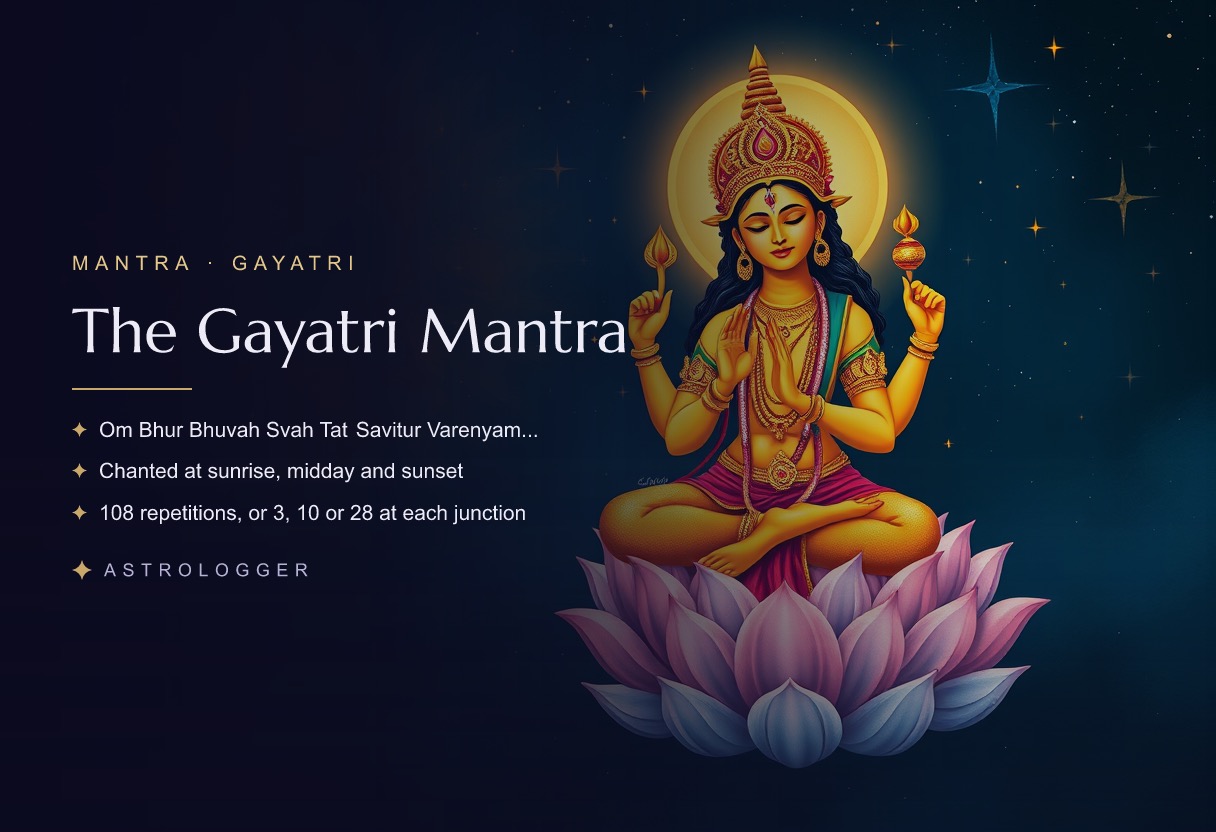
The Gayatri mantra is the same verse given on this site's Surya Mantra page, since it is addressed to Savitr, the Vedic sun as universal illuminator — this page exists separately because "gayatri mantra benefits" is searched as its own question, distinct from "surya mantra." What follows is what tradition actually claims it does, the fuller recitation that surrounds the core verse in formal practice, and honest answers to how and when it is chanted — not a different verse, but a different question about the same one.
The 2 Gayatri Mantras
"Gayatri Mantra" is not a single verse. These are the forms in traditional use, each with its own purpose and count.
| Form | Opening | Count |
|---|---|---|
| The Gayatri Mantra | ॐ भूर्भुवः स्वः तत्सवितुर्वरेण्यं भर्गो दे | 108, or 3, 10 or 28 at each of the three daily junctions |
| Gayatri Shiro Mantra | ॐ आपो ज्योती रसोऽमृतं ब्रह्म भूर्भुवः स्वर | — |
The Gayatri Mantra
ॐ भूर्भुवः स्वः तत्सवितुर्वरेण्यं भर्गो देवस्य धीमहि। धियो यो नः प्रचोदयात्॥
Om Bhūrbhuvaḥ Svaḥ Tatsaviturvareṇyaṁ Bhargo Devasya Dhīmahi, Dhiyo Yo Naḥ Prachodayāt.
The verse in full, exactly as given on this site's Surya Mantra page, since this is the same mantra addressed to the same deity. "Bhūr bhuvaḥ svaḥ" are the three Vyahritis, naming the three worlds — earth, the middle realm, and the heavens — a preliminary invocation tradition treats as a condensed cosmology said before the request that follows. The twenty-four-syllable verse proper, strictly by its metre, begins at "tat savitur" and asks that the adorable splendour of Savitr, that god, illuminate our intellect; the Vyahritis are carried with it as one continuous recitation in every mainstream printing, not a separate mantra on their own.
Count: 108, or 3, 10 or 28 at each of the three daily junctions
Gayatri Shiro Mantra
ॐ आपो ज्योती रसोऽमृतं ब्रह्म भूर्भुवः स्वरोम्
Om Āpo Jyotī Raso'mṛtaṁ Brahma Bhūrbhuvaḥ Svarom
The "head" verse appended after the Gayatri mantra in the fuller Sandhyavandanam recitation. It names water, light, essence, immortality and the absolute (Brahman) together with the three worlds again, closing the full sequence rather than standing alone.
When and how to chant
Day: No fixed weekday — chanted daily, traditionally at three junctions: sunrise, midday and sunset
- Three junctions (sandhya) are traditionally kept: shortly before and after sunrise, midday, and shortly before and after sunset.
- Face east at dawn and west in the evening; midday chanting faces north in most traditions.
- Silent or mental repetition (manasika japa) is held to be acceptable at any time, including night, when audible or vocal chanting at the three junctions is not possible.
- A rudraksha or tulsi mala is traditional; count in rounds of 108, though a shorter count of 3, 10 or 28 repetitions at each junction is also widely kept for those short on time.
- It is traditionally chanted quietly rather than loudly, and the version with the Vyahritis and Shiro mantra is kept for formal Sandhyavandanam; the bare verse alone is acceptable for daily practice.
What tradition holds
Tradition holds regular Gayatri recitation to sharpen concentration and clarity of thought, to support physical and mental steadiness, and — since it is addressed to Savitr as illuminator — to be a request for guidance rather than for a specific material outcome. It is treated as a universal mantra available to anyone regardless of which other deity they are devoted to, which is part of why it sits apart from the deity-specific mantras elsewhere in this cluster. These are the reasons tradition gives for keeping it; they are not medical claims, and not a promise that reciting it fulfills a specific wish.
Watch and chant along
Related mantras
Frequently asked questions
What is the Gayatri mantra used for?
Tradition holds it as a request for Savitr's illumination of the intellect — for clarity, guidance and concentration rather than a specific material outcome. It is treated as universal, chanted regardless of which deity a person is otherwise devoted to.
What happens if we chant Gayatri Mantra every day?
Tradition associates daily recitation, especially at the three sandhya junctions, with sharper concentration and steadiness of mind over time. This is the claim tradition makes for the practice, not a guaranteed or measurable outcome.
Can I chant Gayatri Mantra at night?
Silent or mental repetition is held to be acceptable at any time, including night. Audible chanting is traditionally kept to the three sandhya junctions — near sunrise, midday and sunset — rather than at night.
Can Gayatri Mantra fulfill wishes?
The verse itself asks for illumination of the intellect, not for a specific wish — tradition frames it as a request for guidance and clarity rather than a wish-granting formula. Treating it that way is a popular extension of the practice, not what the verse itself asks for.