 Astrologger
Hanuman Mantra
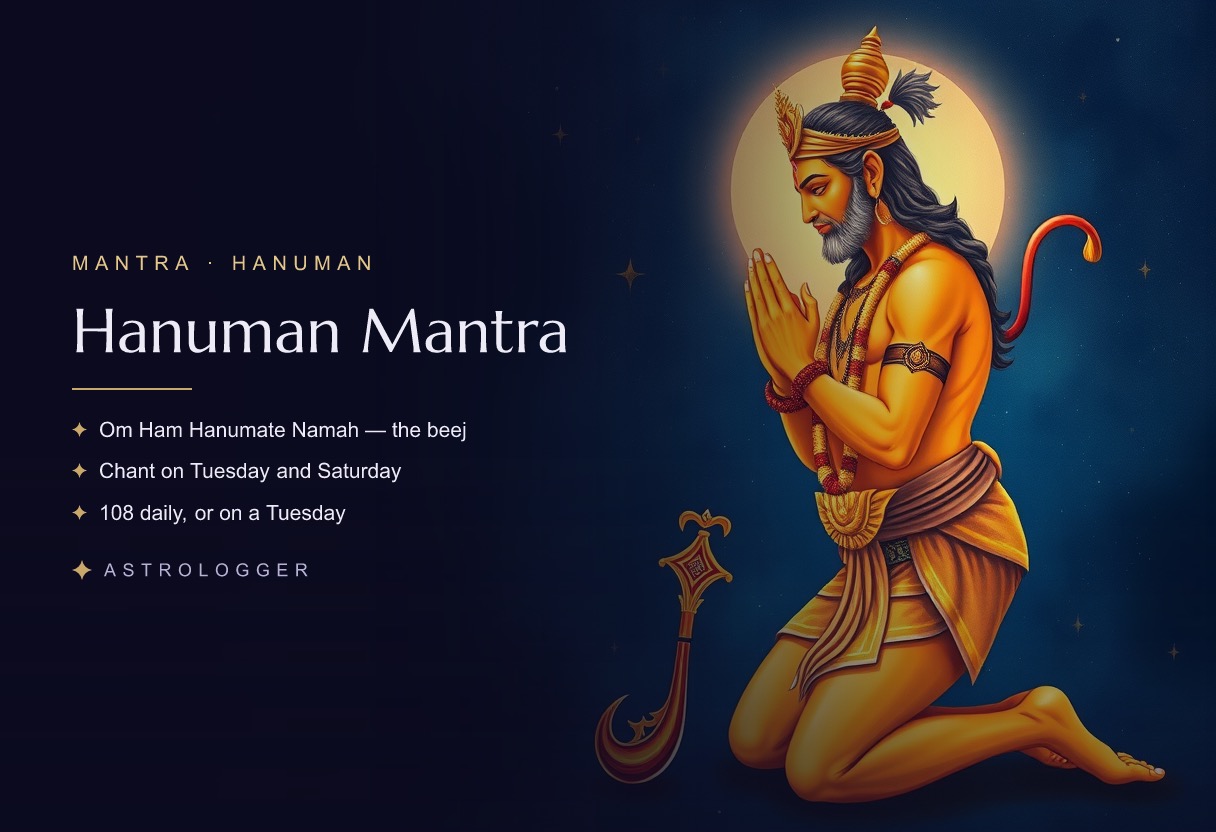
Hanuman is approached for courage, protection and the removal of fear above all — son of the wind god, devoted messenger of Rama, and held in tradition to be the most reliably approachable deity for someone in genuine difficulty. Mantras addressed to him are chanted on Tuesdays and Saturdays, before Hanuman Chalisa or Sundarkand paath, and by anyone facing something that frightens them. As with the other deity mantras here, there is no single one — the family below serves different occasions.
The 4 Hanuman Mantras
"Hanuman Mantra" is not a single verse. These are the forms in traditional use, each with its own purpose and count.
| Form | Opening | Count |
|---|---|---|
| Hanuman Tantra Mantra | ॐ हं हनुमते नमः | 108 daily, or on a Tuesday |
| Hanuman Saamanya Mantra | ॐ हनुमते नमः | 108 daily |
| Hanuman Gayatri Mantra | ॐ अञ्जनेयाय विद्महे वायुपुत्राय धीमहि। | 108 |
| Manojavam (Dhyana Shloka) | मनोजवं मारुततुल्यवेगं जितेन्द्रियं बुद्धिम | 3, before a longer recitation |
Hanuman Tantra Mantra
ॐ हं हनुमते नमः
Om Haṁ Hanumate Namaḥ
"Haṁ" is a seed syllable tuned to him, and the rest is a salutation by name. This is the slightly more tantra-adjacent of the two short forms, used where a seed syllable is wanted alongside the name.
Count: 108 daily, or on a Tuesday
Hanuman Saamanya Mantra
ॐ हनुमते नमः
Om Hanumate Namaḥ
The plainest form — a bare salutation with no seed syllable attached. This is the one usually given to someone beginning the practice.
Count: 108 daily
Hanuman Gayatri Mantra
ॐ अञ्जनेयाय विद्महे वायुपुत्राय धीमहि। तन्नो हनुमत् प्रचोदयात्॥
Om Añjaneyāya Vidmahe Vāyuputrāya Dhīmahi, Tanno Hanumat Prachodayāt.
Built on the Gayatri metre. It names him Anjaneya, son of Anjana, and Vayuputra, son of the wind, then asks that Hanuman direct the intellect.
Count: 108
Manojavam (Dhyana Shloka)
मनोजवं मारुततुल्यवेगं जितेन्द्रियं बुद्धिमतां वरिष्ठम्। वातात्मजं वानरयूथमुख्यं श्रीरामदूतं शरणं प्रपद्ये॥
Manojavaṁ Mārutatulyavegaṁ Jitendriyaṁ Buddhimatāṁ Variṣṭham, Vātātmajaṁ Vānarayūthamukhyaṁ Śrīrāmadūtaṁ Śaraṇaṁ Prapadye.
The verse recited most often before Hanuman Chalisa or Sundarkand paath, to bring his form and qualities to mind. It describes him as swift as thought, fast as the wind, master of his senses, foremost among the wise, son of the wind, chief of the vanara host, and Rama's own messenger, before taking refuge in him.
Count: 3, before a longer recitation
When and how to chant
Day: Tuesday and Saturday
- Tuesday and Saturday are the days associated with him; morning or evening both kept.
- Face east or north while chanting, the directions kept when sindoor and oil are offered to his image.
- A rudraksha mala is traditional; count in rounds of 108.
- Sindoor mixed with jasmine oil, and boondi or jaggery, are commonly offered to him; those keeping a dedicated Tuesday practice traditionally observe celibacy for the day, since he is held to be a lifelong brahmachari himself.
- The mantras are often said as a precursor to Hanuman Chalisa or Sundarkand paath rather than counted in isolation.
What tradition holds
Hanuman is approached for courage, protection from fear, and relief in situations tradition calls Sankat — genuine difficulty or danger, not minor inconvenience. He is held to be unusually quick to respond among the deities, which is part of why his mantras are kept by people in real distress rather than reserved for formal occasions. These are the reasons tradition gives for keeping these mantras; they are not claims about outcomes, and nothing here is a substitute for dealing with a real danger by real means.
Watch and chant along
Related mantras
Frequently asked questions
What is the favourite mantra of Hanuman ji?
The saamanya mantra, Om Hanumate Namaḥ, is the shortest and most commonly given. The Manojavam dhyana shloka is the one most recited before Hanuman Chalisa or Sundarkand. Both, along with the tantra mantra and gayatri, are set out above with Devanagari, transliteration and sense.
What is the moola mantra of Hanuman ji?
Om Hanumate Namaḥ — a bare salutation with no seed syllable attached, the one usually given to someone beginning the practice.
Which mantra is chanted in a Sankat (crisis)?
Tradition points to Hanuman's mantras specifically for Sankat — genuine difficulty rather than minor inconvenience — with the tantra mantra, Om Haṁ Hanumate Namaḥ, or the Manojavam shloka both commonly used, alongside reciting the Hanuman Chalisa or Bajrang Baan in full where more time allows.
What is the raksha (protection) mantra of Hanuman ji?
The tantra mantra, Om Haṁ Hanumate Namaḥ, is the one most kept for protection specifically. The Manojavam shloka, which takes refuge in him directly, is the longer option.