 Astrologger
Shiv Mantra
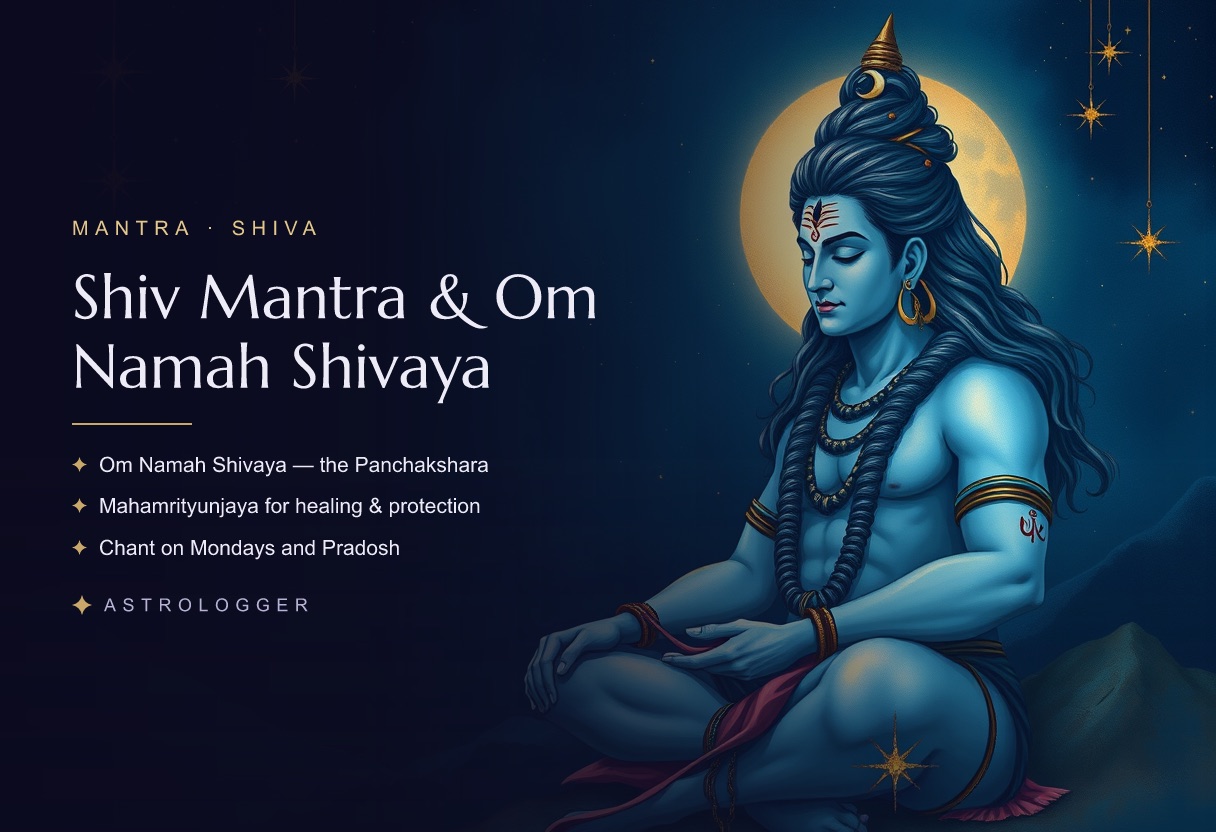
Shiv is approached as Mahadev, the great god, and as Rudra in the Vedas before him — the ascetic among the gods, held to be both the destroyer and the one beyond destruction. Mantras addressed to him are chanted on Mondays, through the month of Sawan, on Mahashivratri, and by anyone seeking steadiness or release from fear of what cannot otherwise be controlled. As with the other deity mantras here, there is no single one — the family below serves different occasions.
The 4 Shiv Mantras
"Shiv Mantra" is not a single verse. These are the forms in traditional use, each with its own purpose and count.
| Form | Opening | Count |
|---|---|---|
| Panchakshari Mantra | ॐ नमः शिवाय | 108 daily, or on a Monday |
| Shiv Beej Mantra | ॐ ह्रौं जूं सः | 108 |
| Shiv Gayatri Mantra | ॐ तत्पुरुषाय विद्महे महादेवाय धीमहि। | 108 |
| Mahamrityunjaya Mantra | ॐ त्र्यम्बकं यजामहे सुगन्धिं पुष्टिवर्धनम् | 108, or 11 rounds on a Monday |
Panchakshari Mantra
ॐ नमः शिवाय
Om Namaḥ Śivāya
The five-syllable mantra — na-ma-śi-vā-ya — tradition maps onto the five elements, earth, water, fire, air and space. This is the one almost everyone knows, the one given first to a beginner, and the one chanted more than any other across this cluster's whole set of pages.
Count: 108 daily, or on a Monday
Shiv Beej Mantra
ॐ ह्रौं जूं सः
Om Hrauṁ Jūṁ Saḥ
A principal seed form, carrying no dictionary sense of its own — sound-seeds tuned to Shiv in his protective, Mrityunjaya aspect. It is the same seed combination that opens the longer Mahamrityunjaya sadhana in some traditions.
Count: 108
Shiv Gayatri Mantra
ॐ तत्पुरुषाय विद्महे महादेवाय धीमहि। तन्नो रुद्रः प्रचोदयात्॥
Om Tatpuruṣāya Vidmahe Mahādevāya Dhīmahi, Tanno Rudraḥ Prachodayāt.
Built on the Gayatri metre. It names him Tatpurusha — "that supreme being" — and Mahadeva, the great god, then asks that Rudra, his Vedic name, direct the intellect.
Count: 108
Mahamrityunjaya Mantra
ॐ त्र्यम्बकं यजामहे सुगन्धिं पुष्टिवर्धनम्। उर्वारुकमिव बन्धनान्मृत्योर्मुक्षीय मामृतात्॥
Om Tryambakaṁ Yajāmahe Sugandhiṁ Puṣṭivardhanam, Urvārukamiva Bandhanānmṛtyormukṣīya Māmṛtāt.
The best known of all Shiv mantras, and among the oldest — found in the Rig Veda. It names him Tryambaka, "the three-eyed one", fragrant and nourishing, and asks for release from the grip of death the way a ripe cucumber falls free of its vine, not for immortality but for liberation from what binds. Also called the Mrita-Sanjivani mantra.
Count: 108, or 11 rounds on a Monday
When and how to chant
Day: Monday, through the month of Sawan above all, and Mahashivratri (Falgun Krishna Chaturdashi) the year's principal occasion
- Monday is the day associated with Shiv; morning after a bath is the usual time, and the month of Sawan the period tradition weighs most heavily.
- Face north — tradition holds the Shivling's own outlet should point that way. Offer bel (bilva) leaves after water, with white flowers, over a Shivling where one is available.
- A rudraksha mala is traditional; count in rounds of 108.
- Fasting on Mondays (Sawan Somwar) is a widely kept observance alongside the chanting, especially through Sawan.
- Mahashivratri, the night of Falgun Krishna Chaturdashi, is the year's principal occasion, kept with a night-long vigil in many traditions.
What tradition holds
Shiv is approached for steadiness, for release from fear — the Mahamrityunjaya specifically for fear of death and illness — and for the detachment tradition holds he embodies as the foremost ascetic among the gods. The Panchakshari is kept as a daily practice needing no particular occasion, while the Mahamrityunjaya is more often reserved for illness, danger, or a genuinely difficult passage. These are the reasons tradition gives for keeping these mantras; they are not a substitute for medical care, and not a claim about what any chant guarantees.
Watch and chant along
Related mantras
Frequently asked questions
What is the favourite mantra of Shiv?
The Panchakshari — Om Namaḥ Śivāya — is the one almost everyone knows and the one given first. The Mahamrityunjaya is the one tradition calls on in illness or danger specifically. Both are set out above with Devanagari, transliteration and sense.
What are the 15 mantras of Shiv?
There is no single fixed list of 15 under that name across sources. What tradition does give consistently are the forms on this page — Panchakshari, beej, gayatri and the Mahamrityunjaya — plus the many names collected in hymns like the Shiva Sahasranama, which lists far more than fifteen.
What are the 10 mantras of Shiv?
As with the "15 mantras" question, there is no one canonical list of ten. The four forms on this page are the ones most consistently published and chanted; longer compilations online group additional names and epithets together under the same heading.
What is the dhyana mantra of Shiv?
The Shiv Gayatri — Om Tatpuruṣāya Vidmahe Mahādevāya Dhīmahi, Tanno Rudraḥ Prachodayāt — functions as the meditation verse, asking that Rudra direct the intellect rather than describing his form in detail the way a dedicated dhyana verse would.