What Does Manglik Dosha in the 1st House Actually Mean?
In Vedic astrology, Manglik Dosha (also termed Kuja Dosha or Mangal Dosha) arises when Mars occupies the 1st, 2nd, 4th, 7th, 8th, or 12th house of a birth chart. While classical traditions vary by region and lineage regarding which houses apply, calculation often extends beyond the primary Lagna (the rising sign) to include the Chandra lagna (Moon sign) and Shukra lagna (Venus reference). Because Venus signifies partnership and the Moon governs emotional temperament, calculating from these points helps practitioners assess relationship dynamics from multiple perspectives.
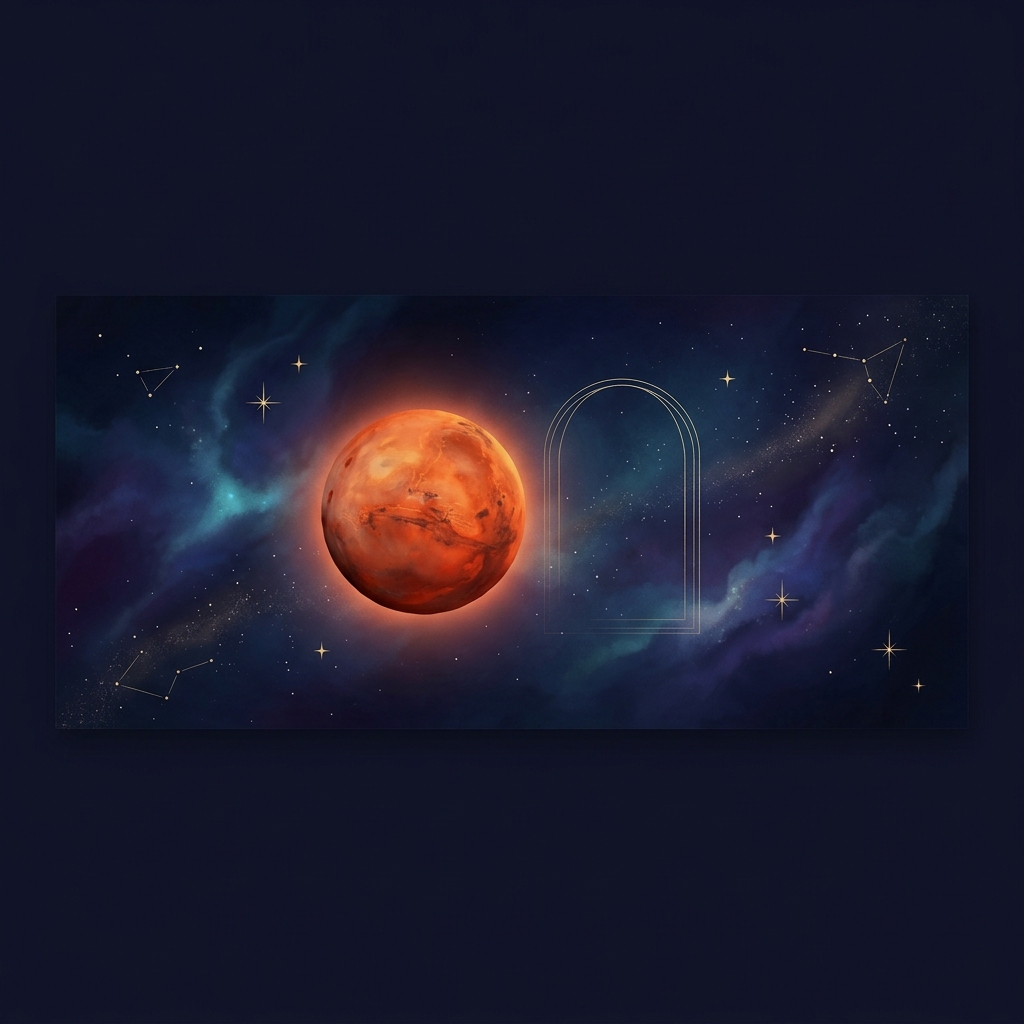
When Mars sits in the 1st house—the Lagna itself—it forms what many traditions regard as the foundational Kuja Dosha. The first house represents physical vitality, outward personality, and personal constitution. Mars brings fiery energy, initiative, and courage to the self, but from this vantage point, it also casts its planetary aspects (drishti) directly onto three crucial domains: the 4th house of domestic peace, the 7th house of marriage, and the 8th house of longevity and shared bonds.
Astrological tradition often distinguishes between "high" and "low" (or partial) dosha based on these reference points. A placement evaluated from the Lagna is traditionally considered more pronounced than one appearing solely from the Moon or Venus. Rather than signifying unavoidable relationship trouble, this configuration simply highlights an assertive nature. When Mars influences both personal identity and marital houses, it invites conscious emotional management rather than alarm, reminding us that an individual chart must always be evaluated in its full, nuanced context.
Ask an AI astrologer about your Manglik dosha. First 3 minutes free (once per account), then ₹10/min.
How Mars in the 1st House Shapes Temperament, Pitta, and Physicality
When Mars occupies the first house—the lagna (ascendant), which governs the physical vessel, vitality, and personal outlook—its fiery nature leaves a discernible imprint on the physiology and temperament. In Ayurvedic and Jyotish traditions, Mars is the primary engine of tejas (inner fire) and rules pitta dosha, the metabolic energy responsible for heat, transformation, and digestion.
Individuals with this placement often display noticeable physical vitality, a brisk stride, and a naturally warm bodily constitution. Classical texts observe that high pitta can incline the body toward inflammatory tendencies, acidity, or skin sensitivity. Because the first house also signifies the head and face, traditional treatises note a recurring pattern: people with an ascendant Mars tend to acquire distinctive facial marks, small scars, or minor head bumps, often earned during energetic pursuits in childhood.
Psychologically, this planetary presence shapes how one engages with the world. Mars embodies initiative, courage, and decisive action. At its best, this energy fosters healthy self-assertion—the capacity to establish clear boundaries, champion worthwhile causes, and meet life's obstacles without retreat. However, when ungrounded, that same heat can shift into chronic restlessness or an impatient temper. Traditional analyses in your kundli look closely at sign dignity: an exalted or own-sign Mars (such as in Aries or Scorpio) often supports dignified leadership, whereas an uncomfortable placement may lean toward irritability. Learning to recognise the subtle line between purposeful resolve and reactive friction is often the central lifelong practice for this placement.
The Drishti Factor: How 1st House Mars Aspects the 4th, 7th, and 8th Houses
In Vedic astrology, planetary influence extends beyond the house a planet occupies through drishti, or planetary aspects. While all planets cast a full glance upon the seventh house opposite them, Mars possesses unique special aspects (vishesha drishti), sending its fiery energy to the fourth and eighth houses as well. When Mars sits in the first house (lagna, representing the self and physical body), this triad of glances directly engages the pillars of one's personal and relational life.
The fourth house aspect reaches the sphere of domestic life, emotional peace, and motherly bonds (matru bhava). Mars casting its gaze here can introduce an underlying restlessness into the home environment. Instead of calm serenity, family life may witness sporadic territorial disputes or an urge to control the domestic space, demanding conscious patience to sustain harmony.
Directly opposite, the seventh aspect falls upon the house of partnership and marriage. This glance sits at the core of the 1st house Manglik condition. Rather than an inevitable conflict, classical tradition views this as dynamic friction: personal initiative meets partnership needs. Mars tends to prompt a strong-willed dynamic where healthy assertive boundaries must be distinguished from hasty reactions or stubborn posturing between partners.
Finally, the eighth house aspect influences shared resources, sudden shifts, and marital longevity. This glance may activate hidden stressors or anxieties around vulnerability and transformation. In a birth chart or kundli, Jyotish texts suggest this aspect can bring periodic intensity to in-law relations or collective finances, asking both individuals to approach joint commitments with transparency rather than secrecy.
How 1st House Mangal Dosha Affects Marriage and Modern Relationships
Few planetary placements carry as much inherited anxiety in Indian matchmaking as Mars residing in the first house (lagna). Traditional folklore often frames this alignment with gloomy finality, yet classical Jyotish treats it as an inquiry into temperament rather than a script for unavoidable separation.
When Mars occupies the first house—the seat of selfhood, physical vitality, and direct impulse—it casts its fourth, seventh, and eighth drishti (aspects) across domestic harmony, partnership, and shared longevity. The direct gaze onto the seventh house of marriage naturally introduces heat. In a modern relationship, this martial drive often shows up as an urge to lead, a low threshold for unresolved ambiguity, or an uncompromising stance on personal autonomy.
The friction, therefore, rarely stems from mystical ill-fortune; it tends to arise when healthy boundary-setting drifts into reactive defence. A partner carrying this fiery influence may instinctively treat compromise as defeat. When met with an equally stubborn response, small domestic negotiations can rapidly escalate into battlegrounds.
Examining a full kundli typically softens this stark picture. An ascendant Mars dignified in its own signs of Aries or Scorpio forms Ruchaka Yoga, expressing courage and steadfast loyalty rather than raw antagonism. Astrologers also weigh the Navamsha (D9) chart to assess whether this initial fire matures into constructive devotion over time. Where modern partnerships succeed with this placement, self-awareness is usually the quiet catalyst. Channelling high-energy impulses into shared physical goals, pausing before reacting, and consciously choosing candid dialogue over unilateral control can turn intense martial energy into deep, protective commitment.
Sign Variations: Ruchaka Yoga vs Debilitation in Cancer Lagna
When analyzing mangal dosha in ascendant charts, the specific sign Mars occupies radically shapes its expression. The first house, or lagna (the ascendant sign rising on the eastern horizon at birth), governs physical vitality and personal orientation. Because Mars projects aspects (drishti) onto the fourth house of domestic life, the seventh of partnership, and the eighth of longevity and shared bonds, its foundational dignity determines whether this energy functions with calm authority or internal friction.
In its own signs of Aries or Scorpio, Mars forms Ruchaka Yoga, one of the five revered Maha Purusha yogas. Here, the traditional fiery temperament of Mars tends to express itself with dignity, purposeful direction, and natural boundaries. Rather than creating destructive conflict, an individual with this placement often displays clear leadership, physical courage, and the ability to protect partnerships while maintaining self-respect. In a personal kundli, this configuration is classically associated with steady drive rather than erratic impulses.
Conversely, when Mars sits in Cancer lagna, it enters its sign of debilitation (neecha). In the watery, lunar environment of Cancer, fiery martial energy frequently feels constrained, struggling to find a direct physical outlet. Classical texts associate this placement with suppressed irritation, defensive reactions, and emotional volatility. The individual may find themselves oscillating between withdrawing their feelings and reacting with sharp, frustrated outbursts when domestic boundaries feel threatened. Examining whether supportive planetary alignments or Navamsha placements soften this condition helps reveal the true balance between reactive friction and genuine emotional resilience.
The Navamsha (D9) Factor: Does 1st House Kuja Dosha Persist?
In Vedic astrology, isolating a single planet in the primary birth chart (the Rashi or D1 chart) often yields incomplete or overly alarming conclusions. When evaluating manglik dosh in first house effects on marriage, experienced practitioners look to the Navamsha (D9) chart to assess its lasting strength rather than assuming automatic friction. The D9 chart represents the inner fruit of the birth chart, illuminating the deeper quality of marriage and personal evolution over time.
To understand whether this intensity persists, one inspects Mars’s dignity within the Navamsha. If Mars occupies an exalted sign (Capricorn) or one of its own signs (Aries or Scorpio) in the D9, its energy tends to express with constructive discipline rather than volatile friction. In such placements, healthy boundaries and genuine courage often replace domestic discord.
Conversely, should Mars fall into its debilitation sign (Cancer) or receive harsh influences in the D9, classical traditions suggest the underlying restlessness may require conscious cultivation of patience.
Mitigating factors carry substantial weight here. Beneficial associations in the D9—such as a harmonious aspect from Jupiter (Brihaspati) or Venus (Shukra)—frequently soften Martian heat, encouraging mutual respect instead of conflict. By evaluating Mars through your full kundli, including its divisional dignities, you gain a grounded perspective that moves past simplistic labels, recognising that planetary placements describe evolving behavioral tendencies rather than fixed marital fates.
What Cancels Manglik Dosha in the First House?
In classical Jyotish, a single planetary placement rarely tells the entire story of a life or a relationship. While analyzing Mars in 1st house Manglik Dosha, traditional texts often focus on its direct aspect (drishti) onto the seventh house of partnership. However, classical authorities outline several balancing conditions that may soften, redirect, or effectively cancel this dynamic.
One of the most widely cited principles is mutual matching. When two people both have Manglik placements in their birth charts (kundli), traditional texts suggest the fiery, assertive temperaments find an energetic balance. Rather than one partner feeling overwhelmed by the other's intensity, both individuals tend to share a comparable drive and directness.
Planetary dignity and aspects also play a defining role. When Mars receives a stabilizing aspect from natural benefics like Jupiter (Guru) or Venus (Shukra), the planet's raw, impulsive edge often channels into protective warmth, ethical leadership, and healthy boundary-setting rather than friction. Furthermore, when Mars occupies its own signs (Aries or Scorpio) or its sign of exaltation (Capricorn) in the first house, it forms Ruchaka Yoga. In such cases, the tradition views Mars not as an affliction, but as a source of courage and vitality.
Finally, classical wisdom accounts for personal growth. Mars is traditionally associated with a natural maturation cycle that stabilizes after age 28. As self-awareness deepens with time, the reactive impulses of youth can transform into emotional resilience, allowing couples to build enduring partnerships rooted in mutual respect.
Authentic Vedic Remedies for Mars in the 1st House
Classical Jyotish approaches Kuja Dosha in 1st house remedies not as magical cancellations, but as conscious disciplines designed to balance planetary energies. When Mars occupies the first house (the ascendant or lagna), its fiery nature directly influences physical vitality and personal temperament. Rather than inviting anxiety, traditional approaches focus on constructive channels for this intense drive.
A grounded physical discipline often serves as the most practical everyday measure. Regular strength training, martial arts, or vigorous exercise can help direct excess pitta (internal heat) and restlessness into healthy focus. In ritual tradition, regular recitation of the Hanuman Chalisa or observing a simple fast on Tuesdays (Mangalwar) is traditionally observed to cultivate humility, patience, and emotional restraint.
Much conversation surrounds Kumbh Vivah, a symbolic pre-marital ceremony involving a pot, tree, or idol of Vishnu. Rather than an absolute requirement, tradition presents this as a quiet psychological and spiritual gesture to absorb turbulent initial marital friction. It is an optional classical rite, not a commercial necessity.
Caution is particularly necessary regarding gemstones. Wearing red coral (moonga) simply because one has Manglik Dosha is ill-advised. Because Mars sits in the first house of the self, red coral amplifies its energy directly into the personality. Unless Mars functions as an unequivocal functional benefic in your kundli — verified thoroughly by a qualified astrologer — strengthening an already dominant placement can unintentionally heighten irritability or impulsiveness. A balanced chart reading always prioritises conscious behavioural adjustments over expensive objects.
Frequently Asked Questions
Does Mars in the 1st house always create Kuja Dosha across all chart views?
Not necessarily across every perspective, as classical traditions evaluate Kuja Dosha through multiple reference points. While Mars in the first house from the primary ascendant (Lagna) traditionally indicates this condition, practitioners also assess the chart from the Moon (Chandra Lagna) and consider potential cancellation factors, such as benefic aspects from Jupiter. Contemporary Jyotish commentary emphasises that a single placement must be weighed within the context of the entire birth chart rather than taken as an absolute rule.
Can two people with 1st house Manglik Dosha marry each other?
Yes, classical Jyotish tradition widely regards a marriage between two individuals with Manglik Dosha as an acceptable and balancing match. The traditional principle suggests that when both partners share similar martial energy and assertiveness, their dynamics tend to harmonise rather than create disproportionate friction. Astrologers nevertheless encourage looking at overall chart compatibility and shared values alongside this specific placement.
How does age 28 alter the intensity of Manglik Dosha in lagna?
In Vedic astrological tradition, Mars is said to mature around the age of 28. Following this milestone, the impulsive or volatile expressions associated with Mars in the ascendant (Lagna) often mellow as personal self-discipline and emotional awareness develop. While the chart placement remains the same, relationship energy tends to be channelled with greater patience and maturity in later years.
Should you wear a red coral for Mars in the first house?
Wearing a red coral is traditionally used to amplify the energy of Mars, meaning it may not be suitable for everyone with Mars in the first house. If Mars is a functional benefic for the specific rising sign, the gem is sometimes worn to support physical vitality, but amplifying an already strong fire could also heighten interpersonal friction. A comprehensive review of the entire birth chart is traditionally recommended before adopting any gemstone practice.
What role does the partner's chart play in balancing 1st house Mars energy?
A partner's chart plays an essential role by providing complementary energies that can soften or constructively channel a first-house Mars. Classical synastry looks for stabilizing factors, such as a strong Moon, well-placed Jupiter aspects, or a corresponding Mars placement that meets assertiveness with mutual understanding. Relationship dynamics in Jyotish are never judged through one chart alone, as the synthesis of both horoscopes determines how mutual energies interact.
 Astrologger